Aachen meteorite
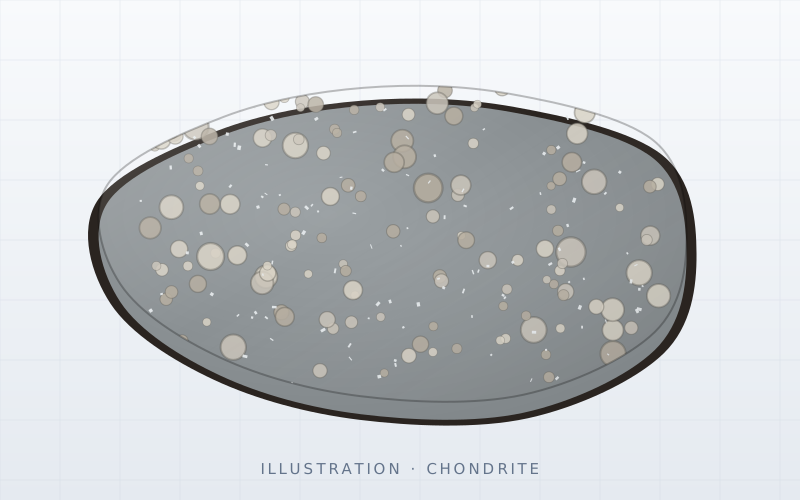
Aachen is an ordinary chondrite meteorite, officially classified as L5, that was seen to fall in Belgium in 1880. A total of 21 g was recovered. Witnessed falls are rare and especially valuable to science, because the stones are collected before Earth's weather can change them.
About Aachen
Aachen is a city in the German state of North Rhine-Westphalia. Aachen may also refer to: Free Imperial City of Aachen (1166–1801), a city of the Holy Roman Empire, formally ruled by the emperor only Aachen (district), in the west of North Rhine-Westphalia, Germany Aachen (electoral district), an electoral constituency represented in the German Bundestag Aachen (meteorite); see meteorite falls Hans von Aachen, (1552-1615), German mannerist painter Aachen fine cloth A family of typefaces designed for Letraset by Colin Brignall
Where it fell
Key facts
- Name
- Aachen
- Classification
- L5
- Type
- Chondrite · Ordinary
- Group
- L
- Fall or find
- Fall (seen to fall)
- Year
- 1880
- Mass recovered
- 21 g
- Country
- Belgium
- Coordinates
- 50.7750° N, 6.0833° E
What is a chondrite?
Stony and primitive. Chondrites still carry mineral grains from the early solar system, often including chondrules. More about L chondrites.
Meteorites near Aachen
- Hautes Fagnes LL5 · 22 km away
- Forsbach H6 · 89 km away
- Tourinnes-la-Grosse L6 · 93 km away
- Bitburg Iron, IAB complex · 95 km away
- Uden LL7 · 103 km away
- Gilzem H5 · 105 km away
Other L meteorites
- Allan Hills 10910 · 2010
- Lewis Cliff 87036 Antarctica · 1987
- Yamato 983759 · 1998
- Larkman Nunatak 06617 · 2006
- Yamato 981501 · 1998
- LaPaz Icefield 04674 · 2004
Introduction shared under Creative Commons licences (Wikipedia, CC BY-SA 4.0).